
Unità di ricerca


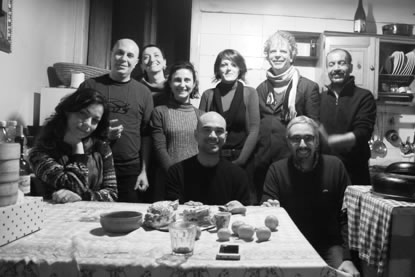
La nostra unità di ricerca è composta da tre giovani ricercatori, Marco Salvemini, Remo Sanges e Vincenza Colonna, e da due ricercatori senior, Giuseppe Saccone e Serena Aceto.
I membri dell’unità hanno una comprovata esperienza nei campi della trasformazione genetica degli insetti, della determinazione del sesso, della genetica di popolazioni ed evoluzionistica, dell’evoluzione molecolare e della bioinformatica.
Tutti i membri dell’unità si conoscono da lungo tempo ed i tre giovani ricercatori hanno condiviso il percorso di studi e formazione prima della separazione e diversificazione dei propri interessi e campi di ricerca.
Questo progetto quindi beneficerà non solo delle competenze complementari acquisite dai vari membri dell’unità di ricerca durante le loro carriere ma anche dei consolidati rapporti interpersonali.
Ciò auspichiamo possa aumentare la qualità e le probabilità di successo del progetto.
1. Sex determination in insects: variations on a common theme. Sex Dev. 2014.
http://www.ncbi.nlm.nih.gov/pubmed/24335049 
2. Human genomic regions with exceptionally high levels of population differentiation identified from 911 whole-genome sequences. Genome Biol. 2014.
http://www.ncbi.nlm.nih.gov/pubmed/24980144
3. De Novo Transcriptome Assembly from Inflorescence of Orchis italica: Analysis of Coding and Non-Coding Transcripts. PLoS ONE. 2014.
http://www.ncbi.nlm.nih.gov/pubmed/25025767
4. The analysis of the inflorescence miRNome of the orchid Orchis italica reveals a DEF-like MADS-box gene as a new miRNA target. PLoS ONE. 2014.
http://www.ncbi.nlm.nih.gov/pubmed/24832004
5. The orthologue of the fruitfly sex behaviour gene fruitless in the mosquito Aedes aegypti: evolution of genomic organisation and alternative splicing. PLoS ONE. 2013.
http://www.ncbi.nlm.nih.gov/pubmed/23418412
6. Integrative annotation of variants from 1092 humans: application to cancer genomics. Science. 2013.
http://www.ncbi.nlm.nih.gov/pubmed/24092746
7. Examples of sequence conservation analyses capture a subset of mouse long non-coding RNAs sharing homology with fish conserved genomic elements. BMC Bioinformatics. 2013.
http://www.ncbi.nlm.nih.gov/pubmed/23815359
8. The OitaAG and OitaSTK genes of the orchid Orchis italica: a comparative analysis with other C- and D-class MADS-box genes. Mol biol Rep. 2013.
http://www.ncbi.nlm.nih.gov/pubmed/23277396
9. Highly conserved elements discovered in vertebrates are present in non-syntenic loci of tunicates, act as enhancers and can be transcribed during development. Nucleic Acids Res. 2013.
http://www.ncbi.nlm.nih.gov/pubmed/23393190
10. An integrated map of genetic variation from 1,092 human genomes. Nature. 2012.
http://www.ncbi.nlm.nih.gov/pubmed/23128226
11. Genomic organization and splicing evolution of the doublesex gene, a Drosophila regulator of sexual differentiation, in the dengue and yellow fever mosquito Aedes aegypti. BMC Evol Biol. 2011.
http://www.ncbi.nlm.nih.gov/pubmed/21310052
12. Ceratitis capitata transformer-2 gene is required to establish and maintain the autoregulation of Cctra, the master gene for female sex determination. Int J Dev Biol. 2009.
http://www.ncbi.nlm.nih.gov/pubmed/19123132
13. Shuffling of cis-regulatory elements is a pervasive feature of the vertebrate lineage. Genome Biol. 2007.
http://www.ncbi.nlm.nih.gov/pubmed/16859531
14. The transformer gene in Ceratitis capitata provides a genetic basis for selecting and remembering the sexual fate. Development. 2002.
http://www.ncbi.nlm.nih.gov/pubmed/12117820
15. The white gene of Ceratitis capitata: a phenotypic marker for germline transformation. Science. 1995.
http://www.ncbi.nlm.nih.gov/pubmed/8533095