Insect sex determination
Insect sex determination
The Insects class is one of the best animal group for studying sex determination mechanisms and their evolution. In fact, sex determination systems in Insects display many and varied mechanisms which have been found to differ both between and within orders and genera, and, in some cases, even between different strains of the same species [1-2-3].
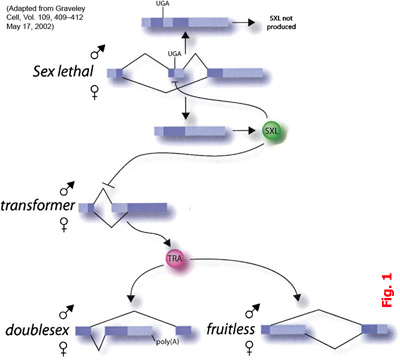
In the model system Drosophila melanogaster (Diptera, Drosophilidae), sex determination is known in details: the presence of two X chromosomes in the female embryos (XX) activates the Sex-lethal gene (Sxl). Sxl, which encodes for an RNA-binding protein, acting as a female-specific splicing regulator, promotes the female-specific splicing of its own and of the transformer (tra) pre-mRNAs. tra and the auxiliary factor transformer-2 (tra-2), both encoding RNA-binding proteins, control the sex-specific splicing of two downstream target genes, responsible of sexual differentiation and courtship behavior: the transcription factors doublesex (dsx) and fruitless (fru), respectively (Figure 1) [4-5]. In XY male embryos, the presence of one X chromosome led to the inactivation of the Sxl gene and of the tra gene. Hence, the target genes dsx and fru are maturated by a default male-specific alternative splicing.
In the last 20 years a homology based approach in species belonging to various insects Orders (Diptera, Coleoptera, Lepidoptera and Hymenoptera) led to the discovery that the Drosophila sex determination genetic pathway is only a partially conserved [5-6-7]. The Sxl orthologs are not involved in sex determination and an ortholog of the tra gene is able to control the female-splicing of its own pre-mRNA in all studied species, as well as to control the female-specific splicing of the dsx and fru genes [3-6-8-9]. An auto-regulating tra gene has been found, to date, in all the examined insect species, with the notable exception of the silkworm and mosquitoes (Figure 2) [7-8].
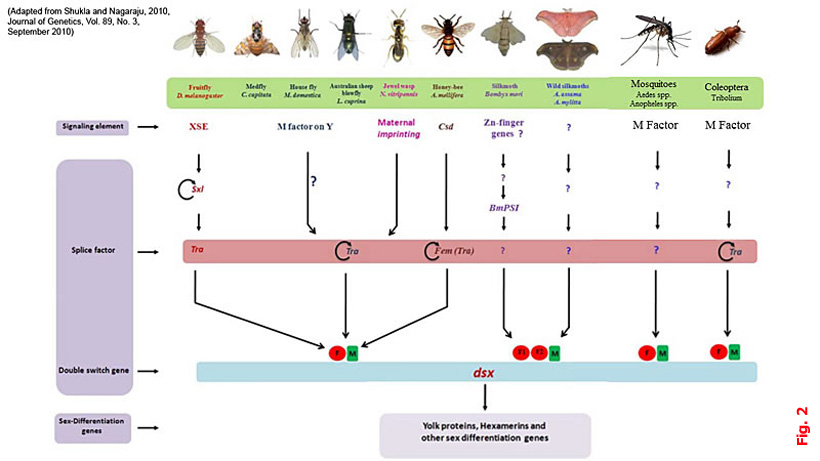
In next years, it will be relevant to understand 1) if the tra-dsx module is also conserved in species of lower Diptera (Nematocera) and in other basal insect orders not yet investigated; 2) how the tra-dsx module is linked with the expression of sexually dimorphic traits; 3) how it contributes to the bewildering variety of dimorphic traits observed in Insects and 4) what is the molecular nature of the primary signals of sex determination controlling the tra-dsx module, which remains elusive, with a functional description achieved only in Drosophila, in the lepidopteran Bombyx mori [10] and in some hymenopteran species [11-12].